Skip to content

News, workshops, exhibitions and cultural program of the Maison Jean Cocteau.

  • The house
    • The house
    • Wo are we?
  • Exhibitions
  • Agenda
    • News
    • Program
    • Contemporary art
  • Practical infos
  • Press
  • School
  • Make a donation
  • Booking
  • En
  • Fr

Exhibitions

Upcoming exhibitions

© Frédéric Beauclair

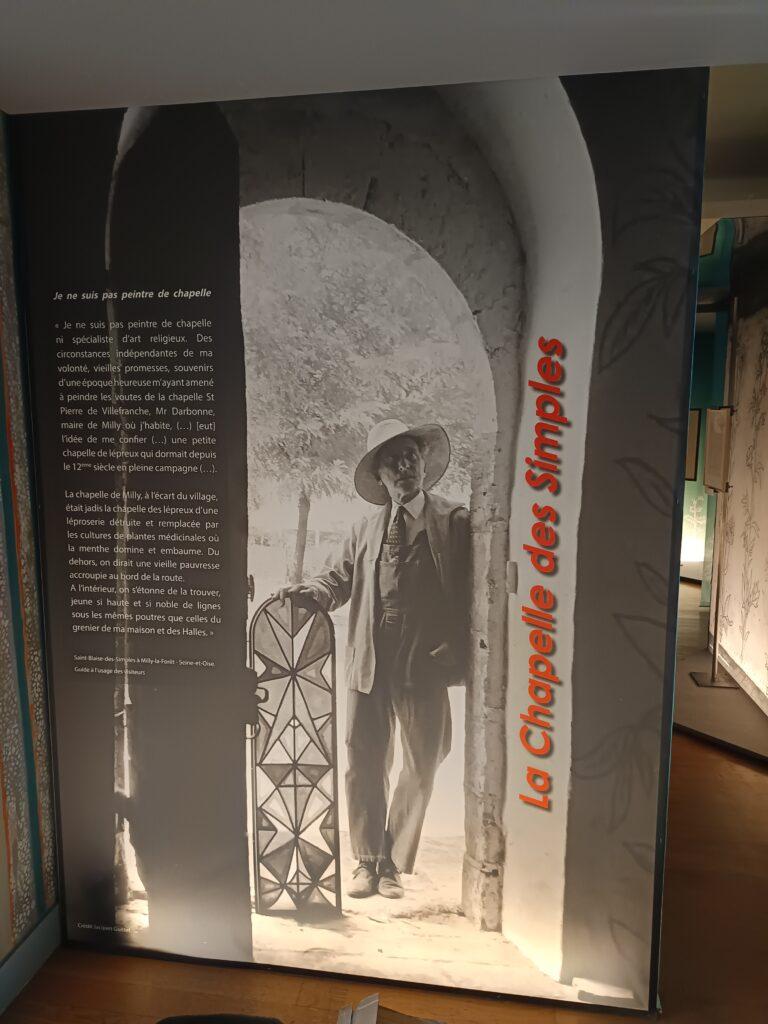
The Chapel of Saint-Blaise des Simples

→ From Saturday 3 May 2025 to Sunday 1 November 2026

In 1958, Jean Cocteau agreed, at the request of the elected representatives of Milly-la-Forêt, to decorate the small chapel of Saint Blaise, located on the outskirts of the village. For this former leper chapel, Cocteau drew inspiration from the medicinal plants, known as Simples, grown in Milly: marshmallow, belladonna, valerian, buttercup, colchicum, henbane, gentian and mint. These large colourful stems, stretching from the floor to the roof along the walls, surround a scene depicting the Resurrection of Christ.

Paying homage to Milly's specialities, the artist repeated a monumental work, following on from those brilliantly executed in the south of France. The scene of the Resurrection of Christ is particularly striking, with its idea of souls ascending to heaven, while Cocteau suggests, through the epitaph engraved on the poet's tombstone, ‘I remain with you’, that this is not the case for his work. Stained glass windows with anthropomorphic geometric motifs, designed by Cocteau and created by a German master glassmaker, complete the ensemble.

Curated by: GIP Maison Jean Cocteau, Muriel Genthon.
Scenography: Frédéric Beauclair.

© Frédéric Beauclair

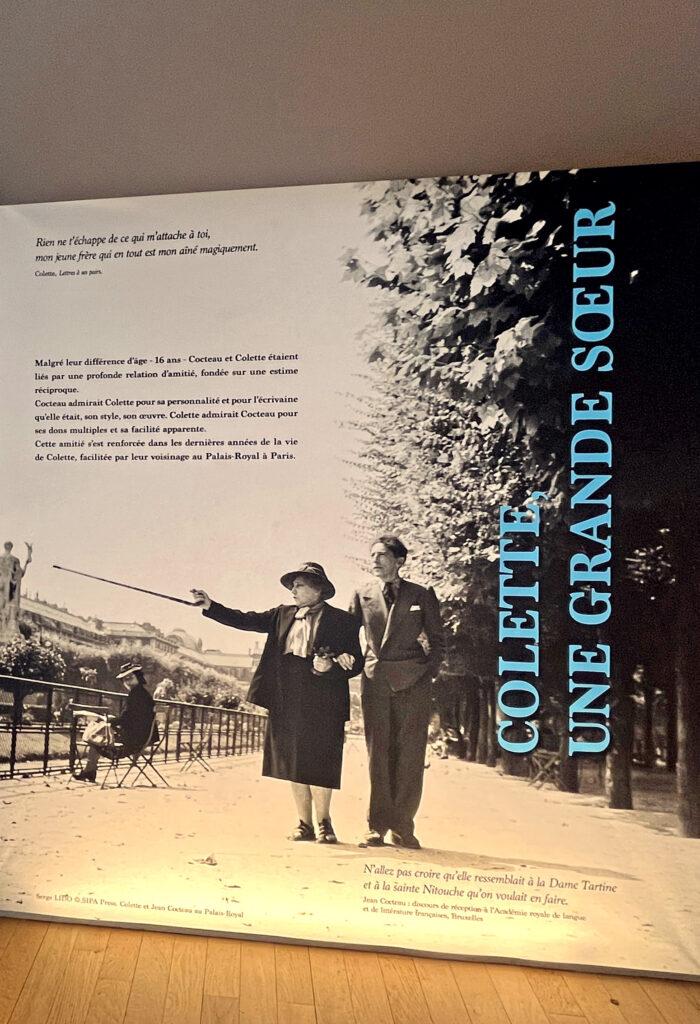
Colette, a Big Sister

→ From Saturday 3 May 2025 to Sunday 31 October 2027

From the 1900s until Colette's death in 1954, Jean Cocteau and Colette shared a friendship, and an artistic and intellectual complicity, like no other. Between the earthbound woman and the tightrope walker, how could such a bond ever have existed? The exhibition Colette, a Big Sister invites you to discover its many facets. It opens on the memory of their first meeting at the Palais de Glace on the Champs-Élysées in 1903, when Cocteau, still an adolescent, caught sight of Colette in cycling dress, a devotee of the pleasures and haunts of Belle Époque Paris. Before becoming her friend and accomplice, Cocteau was fascinated by a young woman who cast off social convention and lived freely, even at the risk of scandal. In the 1930s, as Colette came into her own as an acclaimed writer, the two grew closer still. Neighbours at the Palais-Royal in Paris, they nurtured their friendship through frequent visits, walks in that garden "for grown-ups", and affectionate letters.

As he watched his elder's strength wane, Cocteau became, in Colette's final years, an attentive and loving presence, while she recognised in him the poet who dares everything.

The exhibition gathers drawings, photographs, letters and quotations that bear witness, year after year, to this friendship. At its heart: Cocteau's Portrait of Colette, drawn in charcoal and flour, exceptionally lent by the Centre Pompidou, and an extract from Yannick Bellon's documentary, in which the two old accomplices talk of everything and nothing.

An illustrated booklet accompanies the exhibition. With contributions from two scholars, Nicole Ferrier-Caverivière and David Gullentops, it offers a deeper sense of what drew these two monstres sacrés together, and what fascinated each about the other.

The exhibition is included in your visit to the Maison.

Curated by: GIP Maison Jean Cocteau, Muriel Genthon.
Scenography: Frédéric Beauclair.

Past exhibitions

Marais, the Other Jean

→ From Friday 3 May 2024 to Wednesday 31 December 2025

When Jean Cocteau created Oedipus Rex in 1937, he went looking for someone to play the title role. He was captivated by Jean Marais, a young actor, athletic and sunlit, but wholly untried, and cast him in a silent part.

That meeting was the beginning of a deep bond, made of love, complicity, inspiration and respect, one that would outlast Jean Cocteau's death.

Nothing remains of Jean Marais's bedroom at Milly-la-Forêt. Yet it was he who found the house where Jean Cocteau settled in 1947, and he left behind the memory of a towering film star, adored in the 1950s, who simply came down to the village to pick up his newspaper.

Inside the house, an evocation of the friendship between the two Jeans unfolds through documents and objects that bear witness to it: everyday belongings, sculptures, drawings, photographs and archive images, staged and lit in the former bedroom, which opens onto the garden. Visitors will also discover a work by Jean Cocteau, drawn in chalk on a blackboard, revealed here for the first time.

Curators: GIP Maison Jean Cocteau, Muriel Genthon.
Scenography: Frédéric Beauclair.
© Frédéric Beauclair

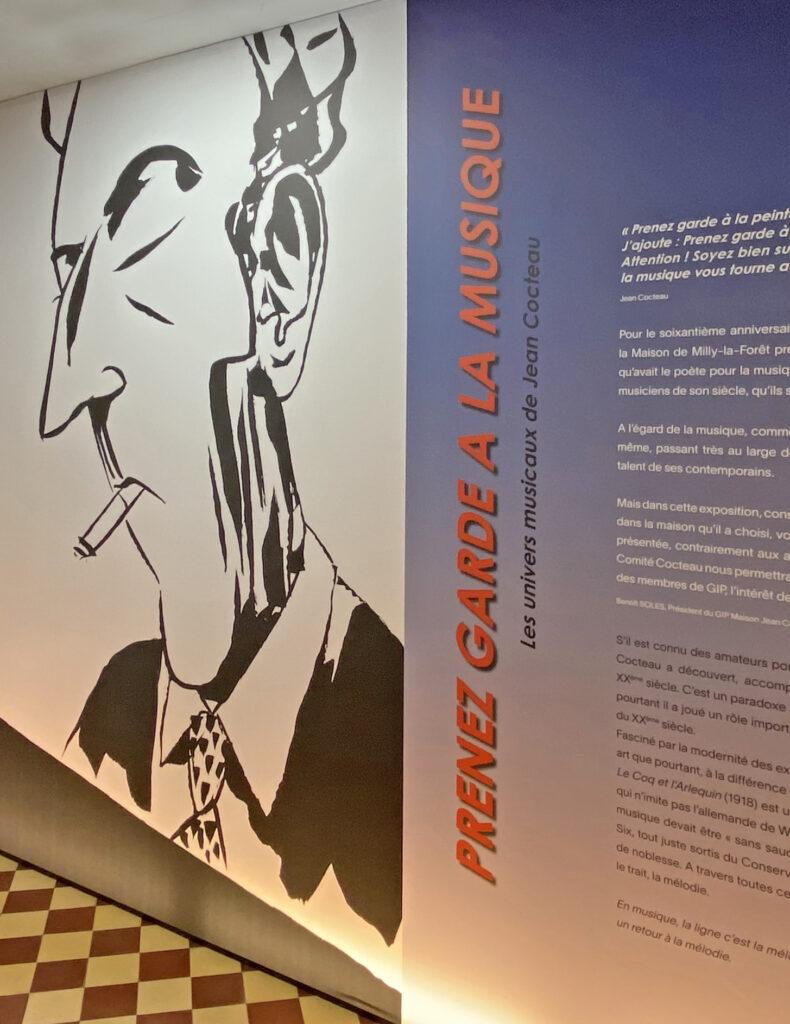
Beware of the Music!

→ From Thursday 1 June 2023 to Sunday 29 October 2023

The temporary exhibition "Prenez garde à la musique: The Musical Worlds of Jean Cocteau" let visitors hear and see the compositions and the musicians who accompanied the artist at every stage of his life.

Cocteau was neither composer nor performer, yet he played a major part in the artistic movements of twentieth-century music. As the "spiritual father" of Les Six, he discovered, nurtured and called forth new musical forms throughout his life. Fascinated by the modernity of artistic expression, he could not turn away from an art he never practised himself, unlike almost all the others.

It all begins in Cocteau's dreamlike, enchanted childhood, lulled by Rossini's piano, which his mother had inherited and played in the family home at Maisons-Laffitte. Every Sunday he also attended the Conservatoire concerts at the invitation of his grandfather, himself a cellist.

Before the First World War, he took part in the Ballets Russes as a librettist and, with Igor Stravinsky's The Rite of Spring in 1913, discovered a music that was expressive, modern, disconcerting… and that held him spellbound. The ballet Parade, created with Erik Satie and Pablo Picasso, marked the starting point of this new spirit.

In the fertile 1920s, Cocteau joined forces with six young musicians eager to break with the aesthetics of the nineteenth century. From this friendship, sealed at Le Bœuf sur le Toit, between the young composers Georges Auric, Louis Durey, Arthur Honegger, Darius Milhaud, Francis Poulenc and Germaine Tailleferre, came emblematic works such as Les Mariés de la Tour Eiffel (The Wedding Party on the Eiffel Tower), a modern farce weaving together dance, pantomime, drama, satire and fairy-tale enchantment, with the musical score intermingled with spoken word.

In 1930, Cocteau inspired the original music Georges Auric composed for his first film, The Blood of a Poet. Orpheus and Beauty and the Beast would follow, their scores still echoing today.

Avant-garde to the extreme and a discoverer of genius, Cocteau was soon dazzled by jazz, which he saw as the chamber music of the twentieth century, a way of writing that was, in his eyes, the poet's own. Later he would write songs for Marianne Oswald, befriend Trenet, Bécaud and Aznavour, and of course Édith Piaf, for whom he wrote Le Bel Indifférent.

Curated by: GIP Maison Jean Cocteau, Muriel Genthon.
Scenography: Frédéric Beauclair.
© Frédéric Beauclair

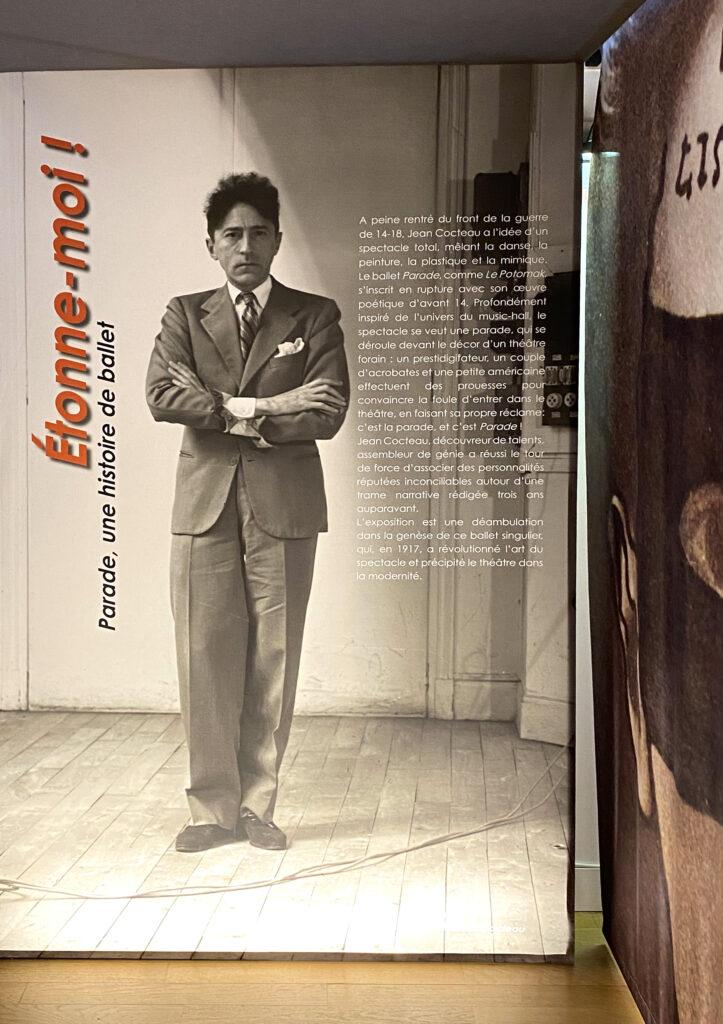
Surprise Me! “Parade,” the Story of a Ballet

→ From Saturday 14 May 2022 to Monday 31 October 2022

Ever in pursuit of the modern, Jean Cocteau created the ballet Parade in 1916, commissioned by Serge de Diaghilev, the impresario of the Ballets Russes in early twentieth-century Paris. Diaghilev, eager to keep pace with the avant-garde, had thrown down a challenge: "Étonne-moi!", "Astonish me!" Cocteau rose to it. At twenty-eight, barely back from the front lines of the Great War, he dreamed up a total spectacle, one that wove together dance, painting, sculpture and mime. Like Le Potomak, the ballet marked a break with the poetry he had written before 1914. Steeped in the world of the music hall, it takes the form of a parade staged before the backdrop of a fairground theatre: a conjurer, a pair of acrobats and a little American girl perform feats to lure the crowd inside, each one advertising their own act. That is the parade, and that is Parade!

Cocteau's genius lay in drawing creative spirits together, becoming the alchemist of very different imaginations: Pablo Picasso for the costumes and sets, Erik Satie for the music, Léonide Massine for the choreography. Collective work was the watchword of this experimental piece of dance and music, and it gave rise to a true "poet's ballet." The first performance, at the Théâtre du Châtelet on 18 May 1917, ended in failure. Three years later the work was revived, and this time it was embraced. It came to be seen as the matrix of the avant-garde ballets of the 1920s. For the first time, everyday reality was danced and modern life took the stage.

Curator: GIP Maison Jean Cocteau, Muriel Genthon.
Scenography: Frédéric Beauclair.
© Frédéric Beauclair

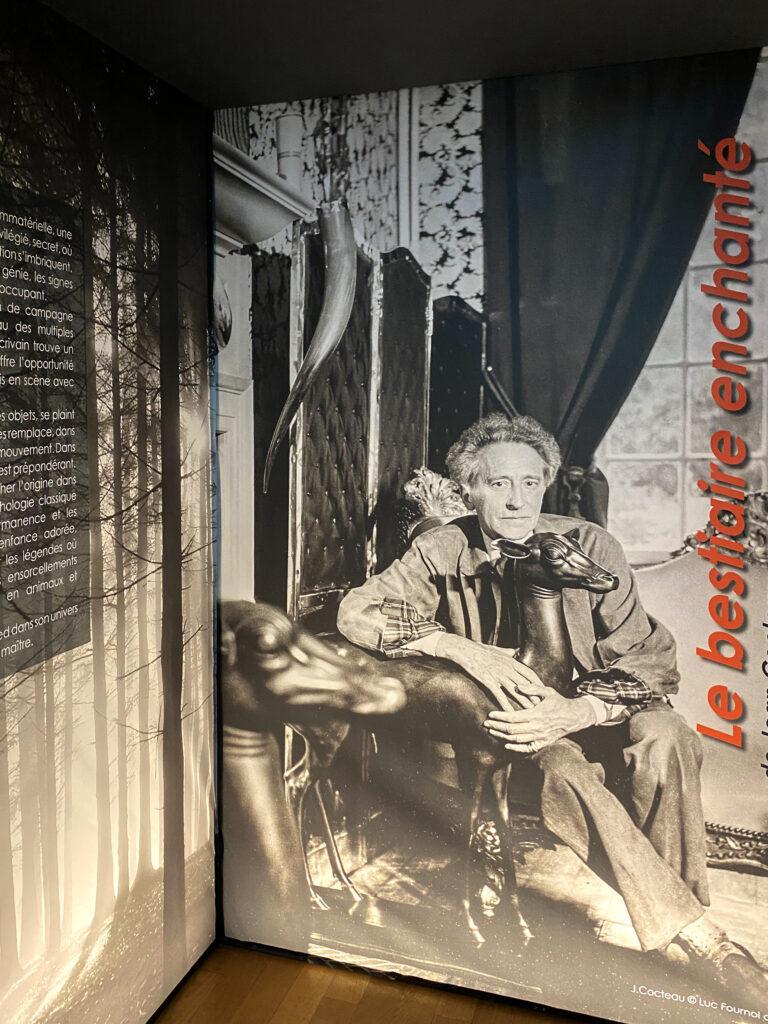
Jean Cocteau’s Enchanted Bestiary

→ From Saturday 14 May 2022 to Sunday 30 October 2022

Deeply inspired by mythology, Jean Cocteau began transcribing the great classical myths, where man and beast become one, as early as the 1920s. His house in Milly-la-Forêt gave him the setting in which to fully compose a universe that echoes his work. He turned to his friend, the decorator Madeleine Castaing, famed for her eclectic taste, to set the stage for a home he arranged over time. Guided by chance discoveries and sudden passions, the poet shaped his house into a theatrical stage set. Sphinxes, a mermaid, a carousel horse mark out the rooms with their presence, answering tapestries adorned with scrolls or leopard-print imitations, horned furniture, and chairs standing on animal feet.

The poet's fascination with these picturesque animal figures has its roots in a cherished childhood, set to the rhythm of fairy tales, where cats wear boots and spells turn humans into animals and back again. That childhood also brought archaeological pieces inherited from his maternal grandfather, Eugène Lecomte, which stirred Cocteau's imagination, carrying him off to a world outside time. Steeped in classical culture and in the emotions of childhood, the poet made the timeless power of the great myths his own throughout his life: myths in which the animal mirrors human passions, a chimerical double. The temporary exhibition "Jean Cocteau's Enchanted Bestiary" brings to light the animals that inhabit the house. It is a plunge into a world that recalls the spirit of his masterpiece Beauty and the Beast, where visitors meet creatures that evoke the poet's passions and tastes.

Curated by: GIP Maison Jean Cocteau, Muriel Genthon.
Scenography: Frédéric Beauclair.

Check your inbox or spam directory to confirm your subscription.

  • Legal Notice
  • Wo are we?
  • Contact
  • Newsletter
Gérer le consentement aux cookies
Pour offrir les meilleures expériences, nous utilisons des technologies telles que les cookies pour stocker et/ou accéder aux informations des appareils. Le fait de consentir à ces technologies nous permettra de traiter des données telles que le comportement de navigation ou les ID uniques sur ce site. Le fait de ne pas consentir ou de retirer son consentement peut avoir un effet négatif sur certaines caractéristiques et fonctions.
Fonctionnel Always active
Le stockage ou l’accès technique est strictement nécessaire dans la finalité d’intérêt légitime de permettre l’utilisation d’un service spécifique explicitement demandé par l’abonné ou l’internaute, ou dans le seul but d’effectuer la transmission d’une communication sur un réseau de communications électroniques.
Préférences
Le stockage ou l’accès technique est nécessaire dans la finalité d’intérêt légitime de stocker des préférences qui ne sont pas demandées par l’abonné ou la personne utilisant le service.
Statistiques
Le stockage ou l’accès technique qui est utilisé exclusivement à des fins statistiques. Le stockage ou l’accès technique qui est utilisé exclusivement dans des finalités statistiques anonymes. En l’absence d’une assignation à comparaître, d’une conformité volontaire de la part de votre fournisseur d’accès à internet ou d’enregistrements supplémentaires provenant d’une tierce partie, les informations stockées ou extraites à cette seule fin ne peuvent généralement pas être utilisées pour vous identifier.
Marketing
Le stockage ou l’accès technique est nécessaire pour créer des profils d’internautes afin d’envoyer des publicités, ou pour suivre l’internaute sur un site web ou sur plusieurs sites web ayant des finalités marketing similaires.
  • Manage options
  • Manage services
  • Manage {vendor_count} vendors
  • Read more about these purposes
Voir les préférences
  • {title}
  • {title}
  • {title}