
The artist
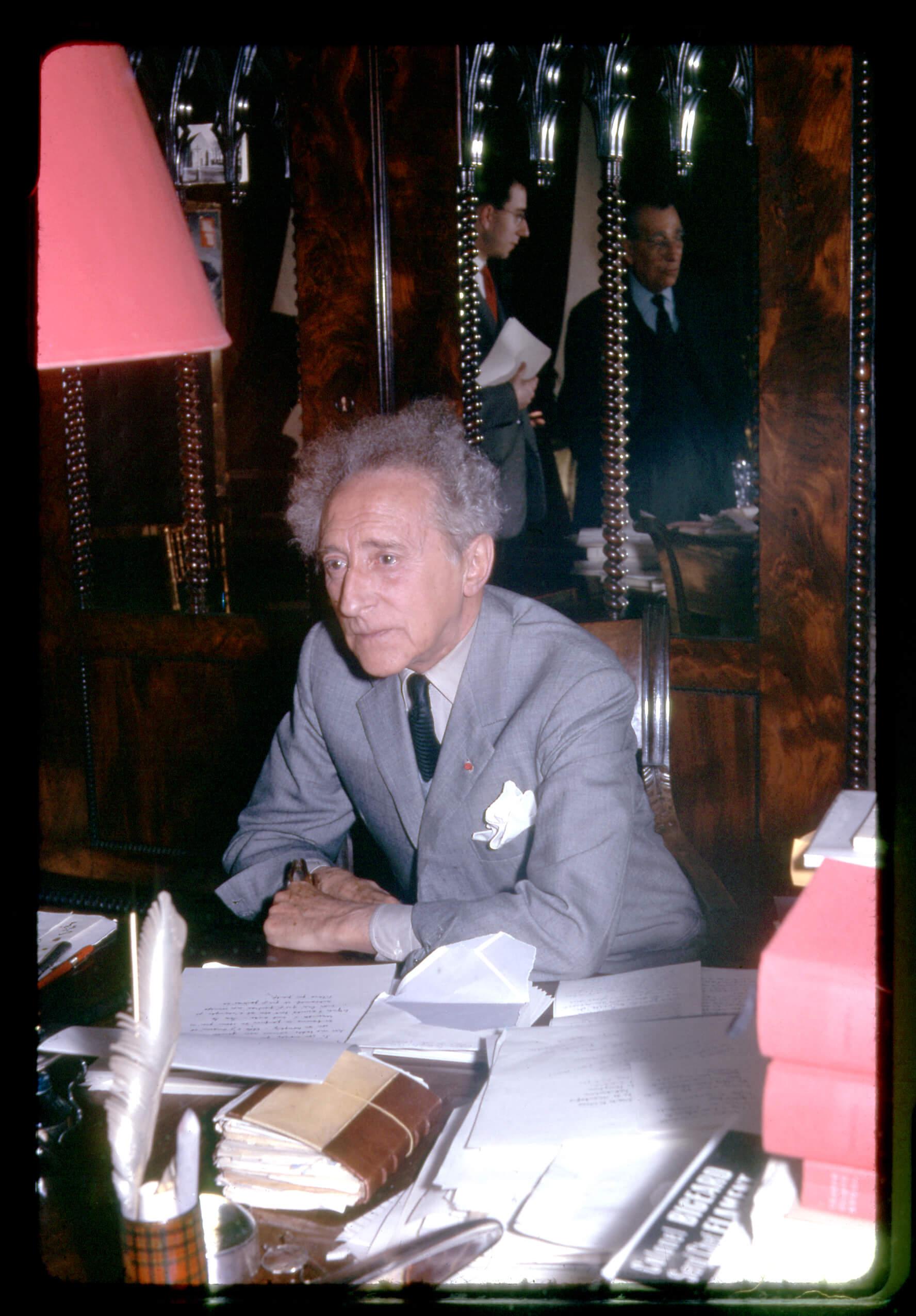
Jean Cocteau, 1962 ©
Jean Cocteau was born in 1889, the same year as the Eiffel Tower, emblem of the Paris World’s Fair. The young Cocteau was born in Maisons-Laffitte into a bourgeois family, moved through Parisian salons, and won admirers by reciting his poems as early as 1907. The Great War radically reshaped the outlook of his generation. In contact with giants like Picasso and Stravinsky, he revealed himself as a total artist — a poet who also worked in the novel, drawing, theatre, and film. Never confining himself to a single discipline, which earned him the image of a “jack-of-all-trades,” he invented hybrid forms of creation, blending different arts, and showed a talent that ignored the boundaries of the past. He left behind a body of work impossible to categorize, both for its astonishing diversity and for the thread that runs through it all: poetry, his very way of looking at the world.
It was this tireless worker, always alert, so far removed from his image as a dilettante, who found refuge in Milly-la-Forêt in 1947 — all while remaining attached to the Palais-Royal apartment in Paris where he lived with Jean Marais. In Le Passé défini, the journal he kept from 1951 until his death, though he writes at length of his travels and his stays in the Midi with Francine Weisweiller, he describes his life at Milly as parentheses of happiness. The vegetation growing, the flowers opening, spring announcing itself, the birds returning after winter — everything is a source of wonder. The births and deaths of his dogs and cats, entrusted to the caretaker couple whenever he was away, form a quiet chronicle of time passing. The Maison is where, far from Parisian society, he could carry forward his many projects — those close to his heart, and those dictated by his fame.
His house has kept the imprint of his stays, and though his silhouette no longer appears in a doorway, though his voice no longer calls out to you, the happiness of being there remains intact.
Benoît Solès
President of the GIP Maison Jean Cocteau
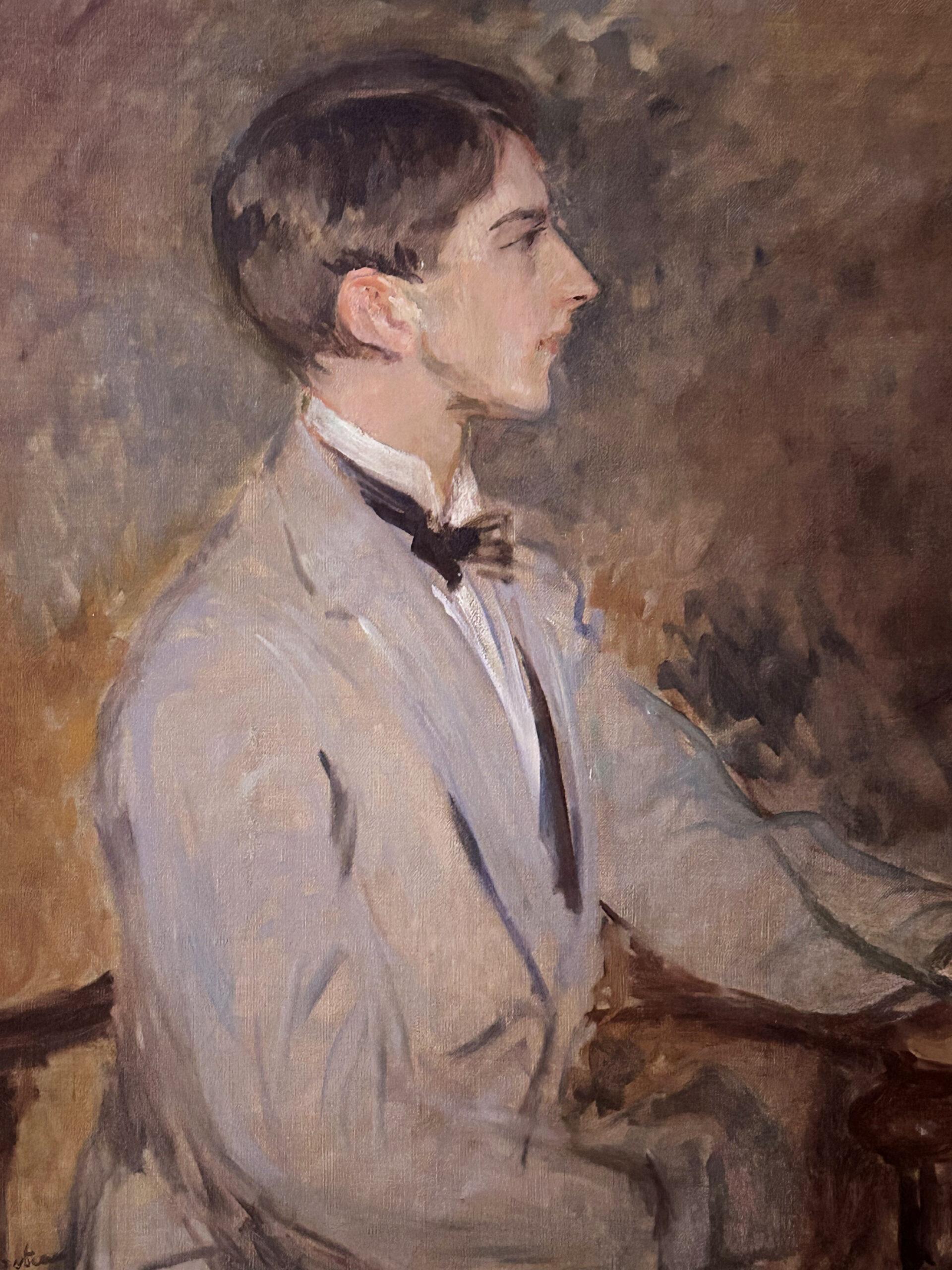
©Maison Jean Cocteau, Jacques-Emile Blanche, (1861-1942), Jean Cocteau, février 1912
A Youth
Jean Cocteau was born in Maisons-Laffitte on 5 July 1889.
Born into the Parisian upper bourgeoisie, he studied at the Lycée Condorcet in Paris. He was nine years old when his father took his own life.
An artistic spirit and an aesthete with a dandy’s temperament, he published his first poems as early as 1909 and became one of the fashionable figures of Tout-Paris, the salons frequented by the Daudets, Countess de Noailles and Marcel Proust. In 1913, Diaghilev’s staging of Stravinsky’s The Rite of Spring was a true revelation for him, one that would shape the whole of his protean body of work.
Enlisted as an ambulance driver during the First World War, he struck up a friendship with Apollinaire. That experience inspired his novel Thomas the Impostor (1923).
The Interwar Years
At the height of his fame, Jean Cocteau went through a period of intense creativity under the banner of the avant-garde. He collaborated with composers such as Erik Satie (Parade, 1917) and Darius Milhaud, and with celebrated painters, Picasso foremost among them.
His writing shows the same curiosity. He tried his hand at poetry inspired by Futurism, Dadaism or Cubism (Le Cap de Bonne-Espérance, 1919), and at the poetic novel (Le Potomak, 1919; Les Enfants terribles, 1929).

Cocteau en 1963. © Fonds Ballerini - Archives départementales 91
From Stage to Screen
He also held a considerable place in the theatre, with Les Mariés de la tour Eiffel (1921), La Voix humaine (1930), La Machine infernale (1934), Les Parents terribles (1938), Les Monstres sacrés (1940), La Machine à écrire (1941), L’Aigle à deux têtes (1946) and Bacchus (1951).
The cinema, in its turn, was to draw Jean Cocteau in. He gave the seventh art films and screenplays of lasting power, among them Le Sang d’un poète (1930), L’Éternel retour (1943), La Belle et la Bête (1946), Les Parents terribles (1948), Orphée (1950) and Le Testament d’Orphée (1960).
“Astonish Me”
To the varied palette of his talents, one must add those of draughtsman and painter. Besides his albums, we owe him the decoration of the chapels of Villefranche-sur-Mer and Milly-la-Forêt.
A brilliant “jack-of-all-trades” and a master of enchantment, this creator, too original to be confined to any one literary or artistic movement, devoted himself to a single master: wonder, his own as much as that of others. “Astonish me,” Diaghilev challenged him in 1912, and he took the dare quite literally.
Jean Cocteau was elected to the Académie française on 3 March 1955.
He died in Milly-la-Forêt on 11 October 1963 and was laid to rest in the Chapelle Saint-Blaise-des-Simples, which he had decorated. www.chapelle-saint-blaise.org
Based on the biography from the Académie française