
News, workshops, exhibitions and cultural program of the Maison Jean Cocteau.
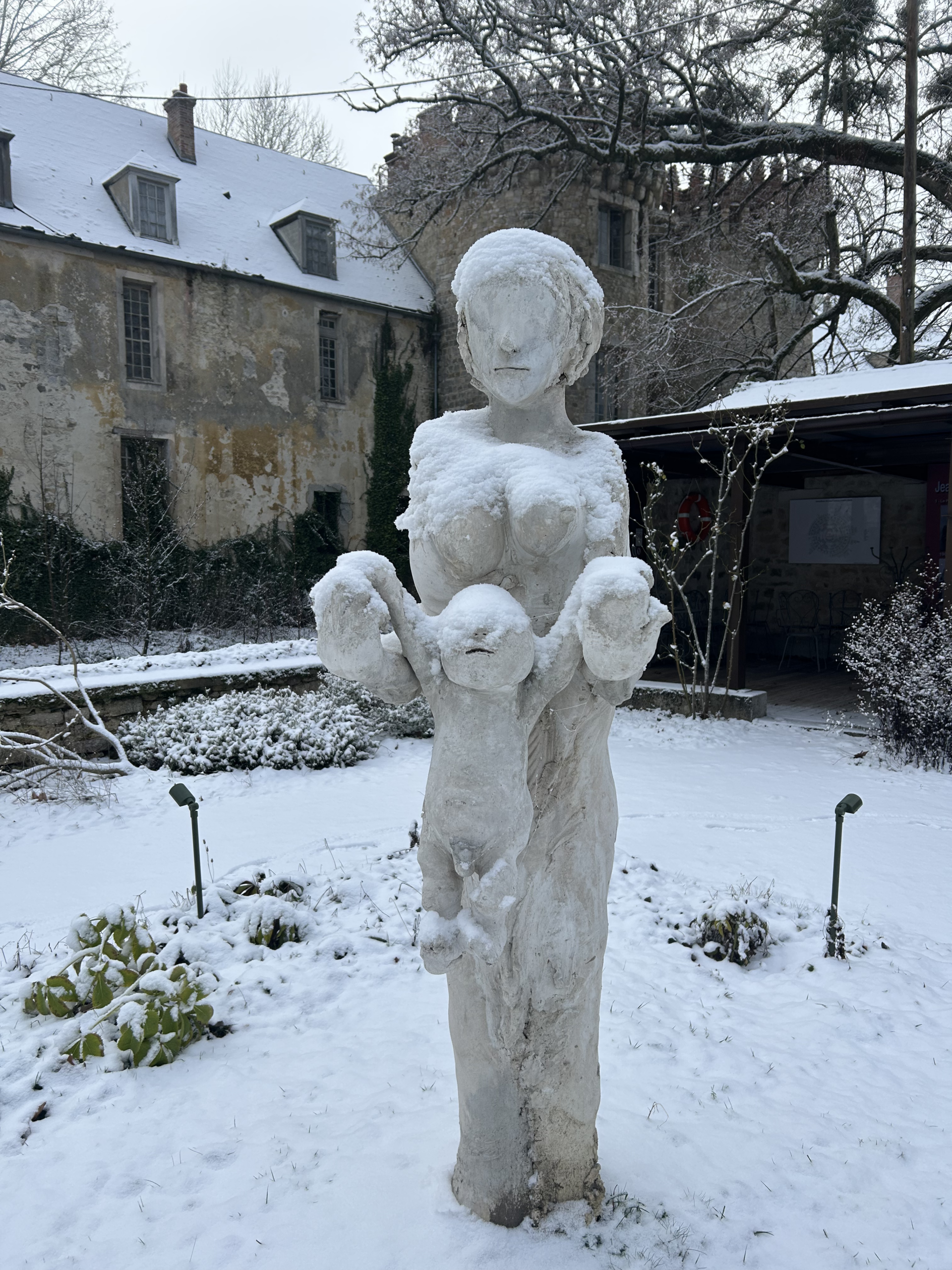
Photo Vierge d’Ile-de-France nord, ciment et plâtre, collection du FRAC Ile-de-France
Art contemporain
Installation of Michel Charpentier’s Works in the Garden of the Maison Jean Cocteau
→ Du Saturday 3 May 2025 au Friday 1 January 2055
rom May 3, 2025, two sculptures by Michel Charpentier (1927-2023), from the collection of FRAC (Regional Fund for Contemporary Art) of Ile-de-France, will be presented in the garden of the Maison Jean Cocteau in Milly-la-Forêt.
In response to the exhibition proposed by FRAC, Berserk and Pyrrhia, on the connections between contemporary art and mediaeval art, which will be presented in both FRAC venues and in twelve off-site locations, the Maison Jean Cocteau is installing the two Virgins of Ile-de-France, works by Michel Charpentier, in the garden facing the entrance.
At first glance, these two Virgin and Child sculptures may surprise viewers with their grotesque and somewhat decrepit appearance. For Michel Charpentier, a devotee of these life-sized outdoor sculptures in gray cement, they reflect suffering humanity, as do his Cantatrices with their wide-open mouths. Referencing the statues of the cathedrals of Ile-de-France, these Virgin and Child sculptures - south and north, as if they had been placed before each of the church portals - are part of the Region's history, a history that the sculptor tints with humor and derision. They will be set against the backdrop of the walls of the old castle adjoining the garden, thus creating a link between the cathedral statues and the medieval origins of the castle. But this Middle Ages is indeed reinvented. Charpentier and Cocteau knew each other: it was in Rome, when Michel Charpentier was a resident at the Villa Medici, that Jean Cocteau noticed his strange sculptures. "It's wonderful! We must help this young man!" said the poet, moved by this vision of suffering humanity, imbued with the sacred. A vision that undoubtedly brings them together.
Biography of Michel CHARPENTIER (September 6, 1927 in Auvers-sur-Oise - July 2, 2023 in Cavaillon)
First Grand Prix de Rome in medal making
Resident at the French Academy, Villa Medici from 1951 to 1955. It was in Rome that he met Jean Cocteau.
Malraux Prize at the Paris Biennale 1963.
Exhibition at the Museum of Modern Art in Paris in 1965
From 1967, member of the steering committee of the Salon de Mai
Professor, head of sculpture workshop at the École des Beaux-Arts in Paris, from 1973 to 1991
Retrospective exhibition in 1991 at the École des Beaux-Arts
Development of his Wood of Sculptures, a landscape space and initiatory garden, in Vallangoujard, in Val d'Oise, from 1994 to 2002
Grand Prix Simone and Cino Del Duca, in 2007
Opening to the public in 2019 of the Michel CHARPENTIER Sculpture Garden, a permanent installation of 25 works, in Valmondois, Val d'Oise
Opening to the public in 2022 of the Michel CHARPENTIER Space, a permanent installation of about twenty works, outdoors, at the chevet of the Saint-Yved abbey church, in Braine, Aisne.
Being born in Auvers-sur-Oise must likely constitute what one calls favorable auspices. But many people were born in Auvers-sur-Oise without becoming painters or sculptors. Having a grandfather who met Van Gogh can be considered a higher sign of destiny. But, again, not all those whose grandfather knew Van Gogh necessarily became painters or sculptors. One must therefore consider that Michel Charpentier, who meets both previous criteria, had other good reasons that drove him to become a sculptor.
The man speaks of his work with great simplicity, with a kind of permanent astonishment in the face of this mystery. "What is sculpture, really? It's solidified dreams!" he confides with a smile. For him, sculpture is what cannot be said or written, it's ultimately quite secret. Michel Charpentier, like an actor, believes he must "get into the character's skin." This skin takes on decisive importance in his sculptures. Wrinkled, swollen, twisted skins and deformed forms participate in a grotesque vision that is nonetheless not devoid of humanity.
His technique of cement worked on a metal framework offers a flexible, living field of work from which humor is not absent. One need only see his cantatrices to be immediately convinced. Michel Charpentier offers us a humanity that swings between tragedy and comedy, and the discourse he maintains appears to me more indulgent than the image he reflects back to us of this world.